
The short answer
Quote the whole job before discounting each tumbler. Our assumed 24-piece pickup order at $24 each leaves $235.79 before fixed overhead and income taxes, after a test blank, labor, packing and two card payments. A 50% deposit brings in cash, but it is not extra revenue or profit. Under the same inputs, $20 per tumbler falls below a 30% contribution target; the calculated floor rounds up to $20.07.
Define the job before quoting a unit price
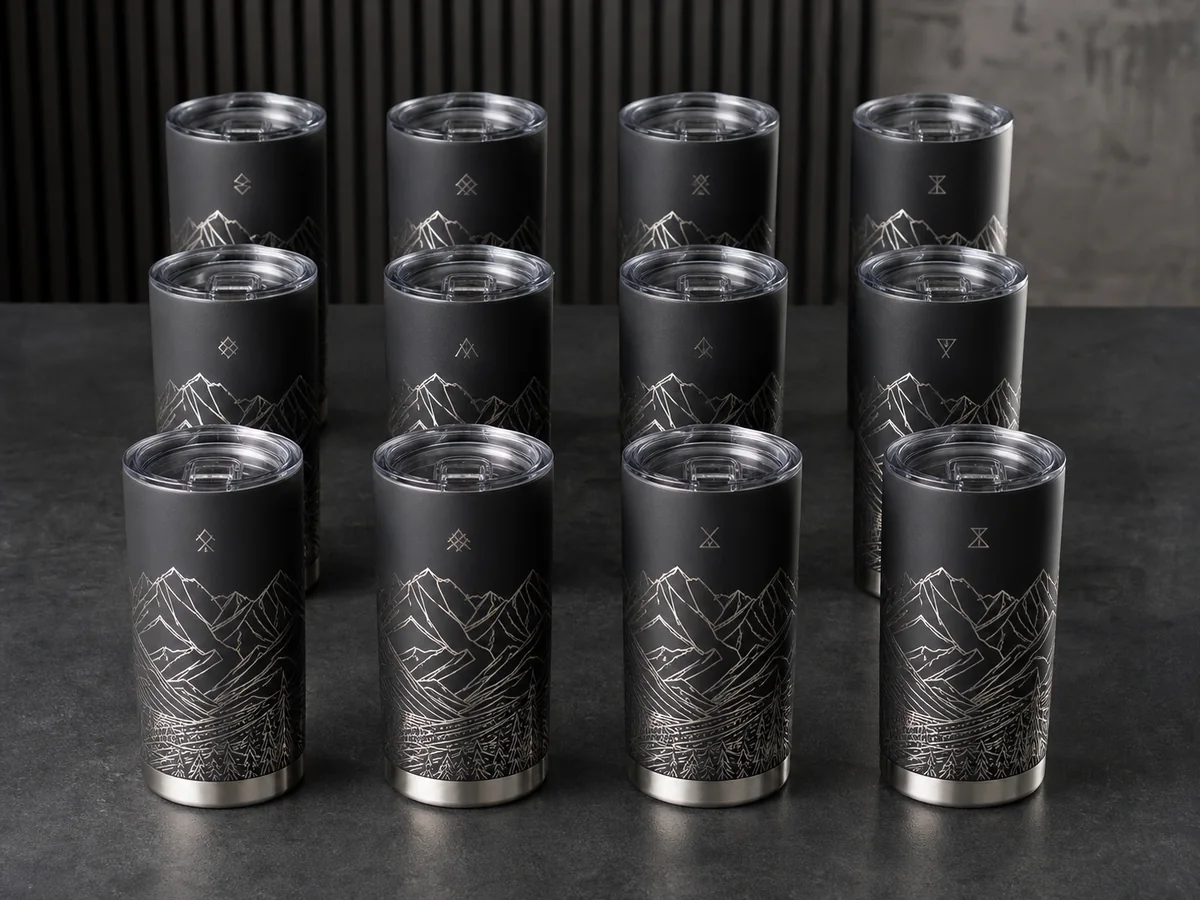
This model is for 24 identical coated tumblers with one approved logo, one engraving location and local pickup. It includes one additional blank deliberately consumed as a setup sample. The 25 blanks are not 25 saleable products. Separate names, extra locations, shipping and more revisions require a new estimate.
The November 23, 2026 Maker Radar uses $32 for a single tumbler, $8.20 for materials and four machine minutes. Those are planning inputs, not observed prices, measured demand or supplier quotes. The $24 bulk price and every production allowance below are hypothetical. Obtain landed blank costs and time the actual workflow.
Write down what artwork approval includes
Give the buyer a written scope: blank model, color, engraving area, quantity, one shared design, one proof revision, final approval deadline and pickup date. Ask the buyer to confirm they may use the supplied artwork. Record the approved file and sample; a quote request is not a paid order.
For individual names, add name-list cleanup, spelling approval, file changes, alignment checks and sorting. Do not assume the same 45-minute setup allowance still applies. One extra hour at the assumed $24 labor rate adds $1 per delivered tumbler to this 24-piece job before fees and any margin allowance.
Calculate the production and packing cost
Assume 25 blanks at $8.20 including delivery to the workshop, four machine minutes per blank at a combined $6 machine-hour allowance, and six hands-on production and packing minutes per delivered tumbler at $24 per hour. Add 45 minutes for the batch proof, sample and rotary setup at the same labor rate, plus $1.25 packing material per delivered item.
The combined machine allowance includes electricity, wear and upkeep; do not add those costs twice. Machine runtime is separate from hands-on work. The setup sample is fully consumed and cannot be sold. These inputs allow no further rejects: if a production tumbler must be remade, add its blank, machine time and labor.
| Batch cost | USD |
|---|---|
| 25 blanks × $8.20 | $205.00 |
| 25 × 4 minutes at $6/hour | $10.00 |
| 24 × 6 minutes at $24/hour | $57.60 |
| 45 setup minutes at $24/hour | $18.00 |
| 24 packing sets × $1.25 | $30.00 |
| Before payment fees | $320.60 |
Include the payment method in the quote
Checked November 24, 2026: Square Free lists 3.3% plus $0.30 for online card payments, including invoice payments. The model assumes two payments at that rate: a deposit and the balance. Other plans, international cards and payment methods can differ; verify the rate applicable to your account.
For arithmetic, the card-payment base equals the $576 goods quote; no tax, tips or other charges are modeled. This is not a conclusion about sales-tax obligations. If tax or another charge is added, calculate processing on the actual collected total and keep tax collected for remittance separate from seller revenue. With two payments, fees are $576 × 3.3% + 2 × $0.30 = $19.608. Contribution is $576 − $320.60 − $19.608 = $235.792, or $235.79 displayed. This model keeps unrounded fees until the end; provider rounding for each payment can change the result by a cent. Reconcile the receipts.
Source: Square — U.S. pricing and online invoice card fees ↗Square Support — Processing fees and payment bases ↗
Set a discount limit before promising a batch price
At $32 per tumbler, the same 24-piece scope leaves $421.46 after the modeled costs. At $24 it leaves $235.79. The discount removes $185.66 of contribution after the lower percentage fee; larger quantity alone does not make that money reappear. Neither scenario is a demand forecast.
For a hypothetical 30% contribution target on this one job, price per tumbler must be at least ($320.60 + $0.60) ÷ [24 × (1 − 3.3% − 30%)] = $20.06497, rounded upward to $20.07. At $20, contribution is $142.96, only about 29.78% of the $480 quote. This floor excludes fixed overhead, financing, income taxes, refunds and extra remakes; it is not a market-price recommendation.
The SBA calculator separates fixed and variable costs for monthly business break-even. Here, setup is fixed only for this defined job, while most other costs scale with units or payments. A positive job contribution still needs to cover monthly business overhead. Recalculate both the job and the business before committing to a machine.
Source: U.S. Small Business Administration — Break-even calculator ↗
Separate deposit cash from job profit
Square supports requesting an invoice deposit by amount or percentage and collecting a later balance; availability of more detailed milestone schedules depends on the plan. Confirm the current workflow before offering a payment schedule. A 50% deposit is an example term, not a required or universally suitable policy.
On the $576 quote, a $288 card deposit less $9.804 processing leaves $278.196 before transfer timing or other deductions. Purchasing the $205 blanks and $30 packing material leaves $43.196 of that cash. This is not profit: production labor, setup and the remaining work still have to be funded. The later $288 balance is the rest of the same sale, not a second sale.
State payment dates, artwork approval, scope changes, cancellation and refund terms clearly before accepting the job. An upfront payment does not guarantee an immediate bank transfer or eliminate refund and dispute exposure. Keep the cash schedule separate from your cost and contribution calculation.
Source: Square Support — Manage invoice deposits and payment schedules ↗
Test one paid batch and reconcile the result
Before taking a larger order, make the setup sample, get written approval, and record actual artwork, handling, engraving and packing time. Four minutes per blank would occupy 100 machine minutes for 25 blanks, before loading delays or downtime. That is not a delivery promise.
After pickup, compare the 24 delivered units, sample use, rejects, labor, card receipts and actual contribution with the quote. Record paid reorders separately from views, inquiries and deposits. Use the calculator for an initial equipment scenario, then add the job-specific setup, packing, payment and overhead lines to your order ledger.
- Keep the approved artwork and the buyer’s name list with the order.
- Requote added names, locations, revisions or rush work.
- Do not count the same labor in both setup and per-item time.
Common questions
Can I offer the same discount for 24 different names?
Only after timing name-list checks, file changes, proof approval and sorting. The shared-logo example does not price that extra work.
Is the 50% deposit a recommended business policy?
No. It is a cash-flow example. Choose terms appropriate to the job and explain payment, cancellation and refund conditions before accepting the order.
Is $235.79 the profit from a real seller?
No. It is an original calculation under stated assumptions, before omitted business costs. Neither $24 nor $20.07 is an observed market price.
Sources and method
Prepared by Maker Business Lab from the primary sources below, checked November 24, 2026. Cost models are our own illustrative calculations, not measured seller earnings, supplier quotes, or market averages. Amounts are rounded for display; formulas use unrounded inputs. Policies and prices can change.